One of the key tasks of a Scrum Master is to be a facilitator and a guide for the team. Facilitating is not about giving technical answers, but about creating the conditions for the team to find them.
Have you encountered teams where everything seems fine but there is little desire to improve? Do team members say they are motivated, but value deliveries do not improve? Do you notice your team has lost momentum? Do you feel your initiatives to motivate them fall on deaf ears?
To facilitate well, you must first understand the team as a whole, but also the individuals within it. This understanding includes facets that go beyond the strict application of their professional role. At a minimum, you should understand which aspects positively motivate them to be more efficient, more careful with quality, or more flexible in the face of change.

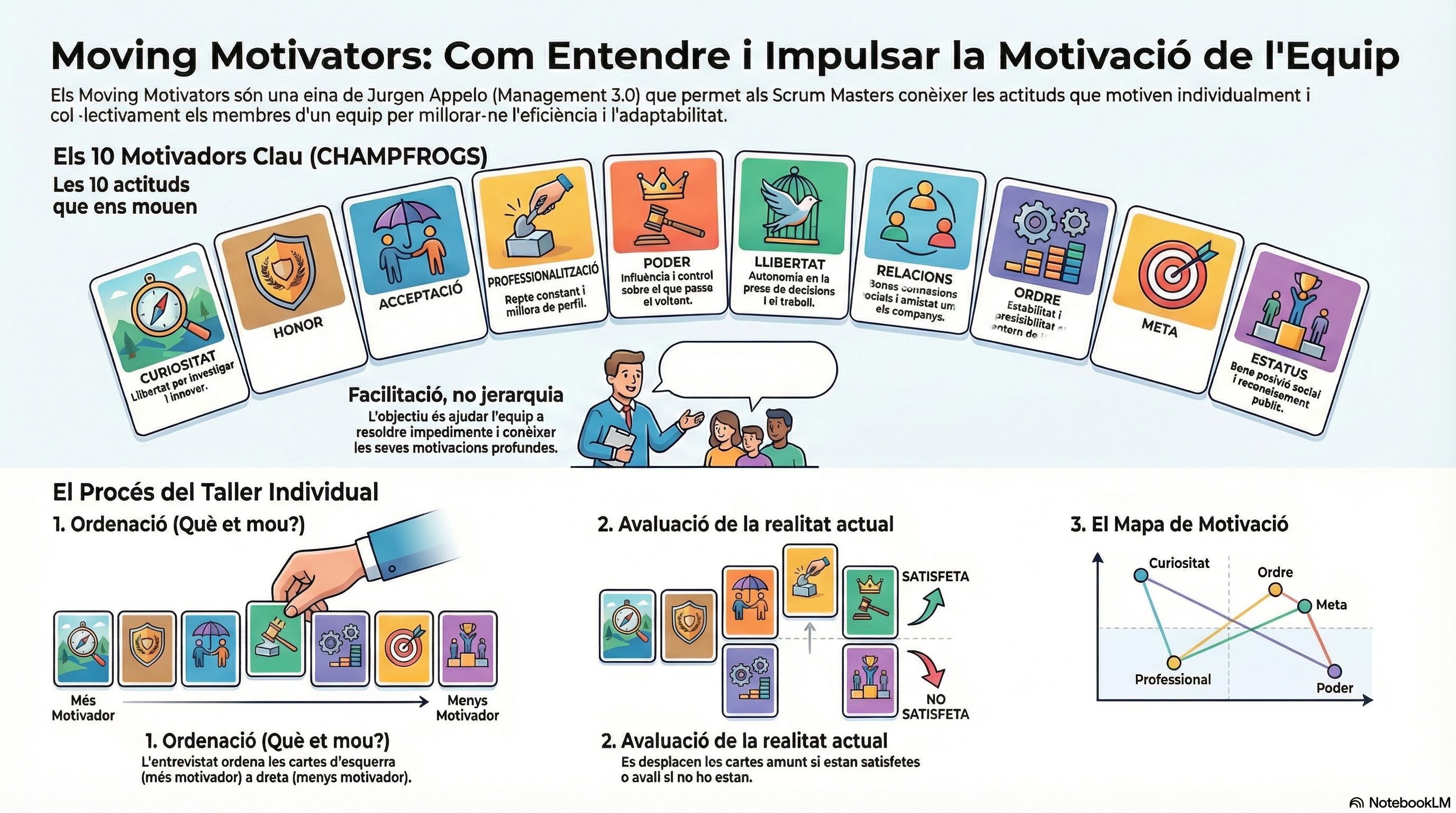
Jurgen Appelo, in his book Management 3.0: Leading Agile Developers, Developing Agile Leaders, proposes a set of aspects to which a person gives special importance when feeling motivated. These aspects are organized around a dynamic known as Moving Motivators.
Moving Motivators help the Scrum Master obtain a snapshot of the aspects that generate motivation in team members; and, with the team’s help, they can agree on a general team motivation map. With this valuable knowledge, the Scrum Master can then help the team find initiatives that improve motivation in these areas.
The aspects identified by Jurgen Appelo are the following:
Moving Motivators is useful at any point in a team’s or project’s lifecycle. Although it can be especially helpful when a team is forming, its real value appears when it is used periodically or during moments of change.
For example, it can be particularly useful during changes in objectives, reorganizations, onboarding of new members, or when a drop in energy or engagement is perceived in the team. It evolves with the context of the project and the people. Therefore, reviewing it over time can provide valuable insights to guide real improvements in team dynamics.
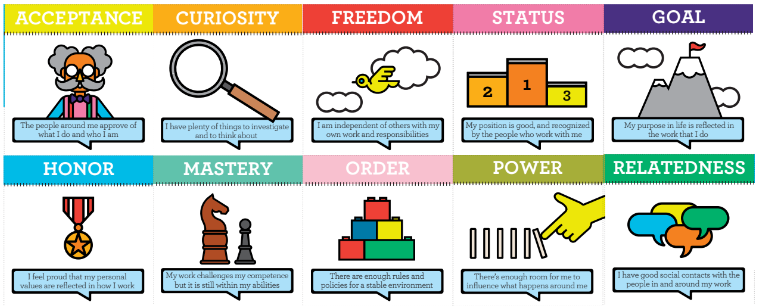
The tools for this activity consist of a card deck describing each motivating attitude, and a motivation map. The card deck includes each of the motivating aspects explained earlier.
The motivation map is used to display in a chart the selection of motivating attitudes chosen by one or more team members during the exercise.
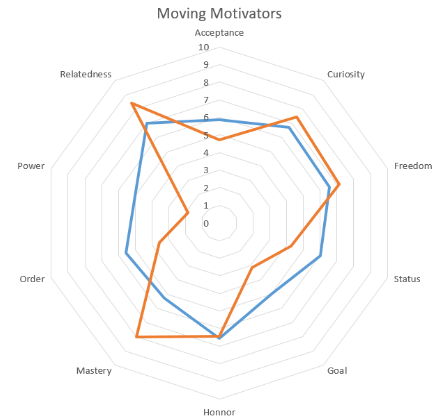
For an individual session, where a team member selects the attitudes they find most motivating and then builds a personal motivation map, you may need around 20–30 minutes per person.
For a session aimed at creating a shared team motivation map based on individual data, you may need between 30 and 60 minutes.
It is recommended to start with a group dynamic that allows sharing perceptions about motivation and satisfaction levels. This first view helps detect patterns, differences, and possible friction points within the team.
To carry out the activity, we will use the motivator card deck explained earlier. Before starting, it is important to ensure everyone understands the meaning of each motivator and to clarify doubts.
Once this is done, the exercise can be deepened through individual conversations where useful. These conversations are not meant to make personal diagnoses, but to better understand nuances that may not appear in a group context.
This Moving Motivators activity pursues three important objectives:
An example of a group dynamic: We gather the team. We provide the full set of motivators explained earlier. If needed, we explain them. It is time to begin with the first objective: Sharing motivators and satisfaction levels:
Once done, we move to the second objective: Studying the overall picture:
To achieve this, it is important to clarify some points:
A common scenario is discovering that half the team values order while the other half values freedom. This is normal. It reflects reality.
With these post-its, we form two clusters: satisfactory motivators and unsatisfactory motivators. We can organize them visually on the board.
Finally, we reach the last objective: Collective improvement action:
Here is where the magic happens. The Scrum Master does not guess solutions individually. The goal is for actions to emerge naturally from conversation and for the team to agree on what to do and how.
This is not a Project Manager forcing team building. It is a committed team actively seeking improvement.
Often the exercise can end here. However, it can also be complemented with more specific individual insights through interviews:
The key question is: What drives you?
The person orders the cards from most to least motivating, placing the most motivating on the left and the least on the right.

The Scrum Master asks: Briefly explain why you ordered them this way.
The person can adjust their order after reflection.
Question: What level of satisfaction do you currently experience for each motivator?
Cards are moved up (satisfied), down (unsatisfied), or left neutral.
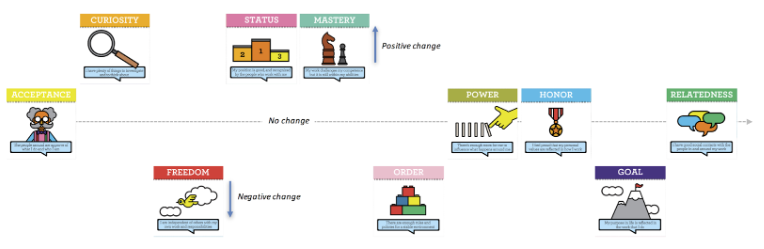
Both can build the personal motivation map as shown:
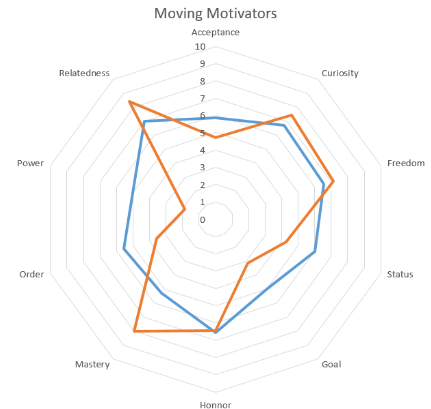
This chart shows two coordinates for each motivator. In blue we draw the importance given in part 1. In red we show the declared satisfaction level.
Ideally, key motivators are also satisfying, but this is rarely the case. Dissatisfaction in key motivators matters more than in minor ones.
The group exercise can be repeated periodically to provide fresh insights on motivation and satisfaction.
Example: Núria is brilliant but seems disengaged. More flexibility does not help. The exercise reveals Honor is her key motivator but satisfaction is 2/10. Her work does not align with her values.
The Scrum Master is not a therapist. Within limits, they can help her identify actions:
If many value Freedom but satisfaction is low, this may indicate bureaucracy or micromanagement.
The team, with Scrum Master facilitation, might:
Moving Motivators is a proven tool that helps Scrum Masters and teams better understand what truly drives motivation.
It may be ineffective or even counterproductive in high-conflict teams, rigid hierarchies, or environments lacking psychological safety.
Improvement actions should be treated as experiments, time-boxed (e.g., Sprints), and reviewed.
These dynamics must be observed over time, revisited periodically, measured in Sprint Retrospectives, and adjusted when needed.
Moving Motivators management30.com (https://management30.com/practice/moving-motivators/)
Retrospective with Management 3.0: Moving Motivators Knowledge21 (https://es.k21.global/blog/retrospectiva-moving-motivators)
Moving Motivators (Champfrogs) | Understanding people’s motivators JorgeRuizAgile (https://www.youtube.com/watch?v=-ZfpcFBBDYc)
![calaix[À]gil.com](/img/logo.png)