This article is a continuation that provides a bit more detail on the metrics defined in the article Don’t look for fast teams, build effective teams.
That article explains that effectiveness can be the concept that guides the work of agile teams, as well as communications with the organization, above efficiency or efficacy.
Thus, that article proposes a list of aspects or metrics that can help us be more effective as a team:
These elements make it possible to evaluate effectiveness with a broader scope and aligned with the principles of continuous improvement, learning, and sustainability typical of agile environments. All these indicators, which we will discuss below, help us understand not only how much is delivered, but how healthy the work system is.
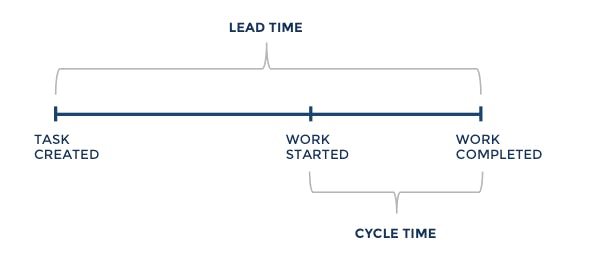
As we saw in the previous article with more detail Don’t look for fast teams, build effective teams, when analyzing a team’s effectiveness, the focus is often placed on technical construction time (cycle time). However, before a need reaches the construction phase, it usually goes through discovery, definition, validation, and prioritization processes (lead time). These processes also consume time and resources, and directly influence the final value we will be able to deliver.
For this reason, optimizing workflow must consider the entire process, from the initial idea to delivery. Improving only the construction phase may result in technical improvements, but not necessarily in better results, value, or suitability.

The quality of the work management tools in the team’s hands has a direct impact on effectiveness. The Product Backlog and Scrum Boards (or boards) are not just visualization tools, but mechanisms to facilitate decision-making and value generation.
A quality Product Backlog contains items with some important characteristics:
In this sense, user stories are a common and useful tool that helps all parties define valuable items in the Product Backlog.
When the backlog does not meet these quality conditions, doubts arise, work must be redone, and the team loses focus.
Scrum Boards reflect the state of the workflow in real time. If the backlog is confusing or outdated, boards end up showing unreliable information, which makes coordination and planning more difficult.
Conversely, clear and updated Scrum Boards help visualize bottlenecks, detect blockers so the team can act, and support decision-making to meet the commitments set at the start of the cycle.
Improving backlog and board quality is not just the responsibility of a specific role (Product Owner or Scrum Master), but a collective practice aimed at improving transparency and workflow.
Some useful indicators or metrics to assess this quality may be:
In short, a quality backlog and boards not only organize work, but also improve the team’s ability to make informed decisions and generate value sustainably.

As we saw in the previous article with more detail Don’t look for fast teams, build effective teams, result quality is a key factor in a team’s real effectiveness. Delivering quickly but with defects, technical shortcomings, or unvalidated product leads to extra work, higher costs, and loss of trust.
The DoD helps prevent increments from accumulating technical debt or degradation that affects overall product quality. For this reason, systematic compliance with the DoD is also a relevant effectiveness indicator. A team that delivers increments meeting the DoD reduces refactoring needs, improves product reliability, and enables decision-making based on truly finished and usable increments.

Bugs are a common risk in product development. Their management has a direct impact on team effectiveness. Measuring bugs helps us understand:
Not all incidents are bugs. They are sometimes confused with new needs, improvements, or requirement changes. Not all bugs have the same impact either. Classifying them by severity and urgency enables better decisions.
There is no single way to manage bugs. Common strategies include:
In any case, it is important to make the effort of fixing a bug visible. This work consumes capacity and influences Sprint commitments and goals. Acknowledging it supports realistic conversations about commitments and priorities.
Problem description
A team faces a high bug ratio affecting delivery quality and organizational trust. Each delivery brings bugs that impact the next Sprint and the team’s focus.
What does this tell us?
Something is wrong. One might first think it is a QA, DoD understanding, or technical quality issue. But that may not be the real cause. We must analyze the origin of these bugs, and we may discover it is actually a requirements understanding issue.
Possible impacts if not addressed
A team that normalizes living with a high error rate may suffer clear negative effects:
Possible solution
If we analyze bug origins, we may find deeper causes beyond technical skills. Perhaps the team experiences requirement changes during the Sprint that destabilize initial goals. In that case, the solution would be to ensure an adequately refined Product Backlog.
As we saw in the previous article with more detail Don’t look for fast teams, build effective teams, in iterative environments, each product increment should provide some kind of value. This value is not always product increments; it can be learning, hypothesis validation, or uncertainty reduction.
When increments are not used or validated, one of the main strengths of iterative cycles is lost: continuous feedback. Without feedback, the risk of building the wrong solutions increases.
For this reason, it is useful to distinguish between output (what is built) and outcome (the impact it generates). A team may have high output and yet low real impact.
The satisfaction of people involved in the product is a relevant indicator of sustainability and effectiveness. A system that generates frustration, even if it delivers results, tends to lose effectiveness over time.
Satisfaction can be viewed from two complementary perspectives: stakeholders and the team.
Stakeholder satisfaction relates to perceived value, trust in the team, and responsiveness to change. It can be captured through feedback, surveys, or conversations.
Team satisfaction relates to maintaining a sustainable pace, clarity of goals, and perceived impact. Low-satisfaction teams tend to see performance decline over time.
Agile ceremonies like the Sprint Review or the Sprint Retrospective can provide signals, but they do not replace concrete evaluation tools. Their main value is enabling open conversations and spotting trends, not evaluating people.
Satisfaction evaluation is relevant for improving team efficiency. It brings a human and relational dimension to teamwork and communication.
Measuring efficacy makes sense when it helps make better decisions. Measurement should not become an end in itself. Metrics, evaluations, and tools are means to achieve cohesive teams, better communication, and better products.
Working with these metrics aims to spark improvement conversations, not to feed dashboards or audit teams. Let’s turn this information into catalysts for collaboration and mutual understanding between teams and the organization.
In the article Don’t look for fast teams, build effective teams, we show practical examples of how, even with low technology, we can extract valuable insights to guide teams and organizations toward effectiveness.
Ultimately, an effective team is one that generates real value sustainably over time. That is the true goal of agility. Good products are built by good teams, and good teams thrive where value and sustainability matter more than speed.
![calaix[À]gil.com](/img/logo.png)